AWS Service - ElastiCache
I currently work
ElastiCache:
Overview
The same way RDS is to get managed Relational Databases
ElastiCache is to get managed Redis or Memcached
Caches are in-memory databases with really high performance, low latency
Helps reduce load off of databases for read intensive workloads
Helps make your application stateless
AWS takes care of OS maintenance / patching, optimizations, setup, configuration, monitoring, failure recovery and backups
Note: Using ElastiCache involves heavy application code changes
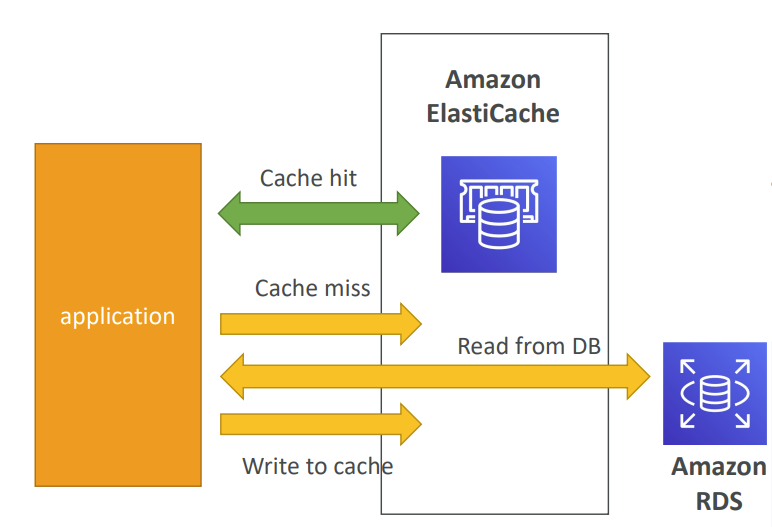
Solution Architecture - DB Cache
Applications queries ElastiCache, if not available, get from RDS and store in ElastiCache
Helps relieve load in RDS
Cache must have an invalidation strategy to make sure only the most current data is used in there
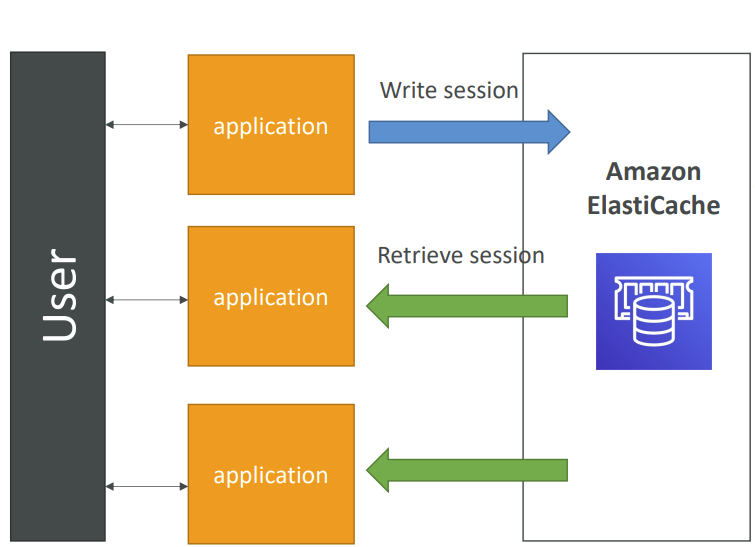
Solution Architecture – User Session Store
User logs into any of the application
The application writes the session data into ElastiCache
The user hits another instance of our application
The instance retrieves the data and the user is already logged in
ElastiCache - Redis
Multi AZ with Auto-Failover
Read Replicas to scale reads and have high availability
Data Durability using AOF persistence
Backup and restore features
Supports Sets and Sorted Sets

ElastiCache - Memcached
Multi-node for partitioning of data (sharding)
No high availability (replication)
Non persistent
No backup and restore
Multi-threaded architecture

Cache Security
ElastiCache supports IAM Authentication for Redis
IAM policies on ElastiCache are only used for AWS API-level security
Redis AUTH
You can set a “password/token” when you create a Redis cluster
This is an extra level of security for your cache (on top of security groups)
Support SSL in flight encryption
Memcached
- Supports SASL-based authentication
Patterns for ElastiCache
Lazy Loading: all the read data is cached, data can become stale in cache
Write Through: Adds or update data in the cache when written to a DB (no stale data)
Session Store: store temporary session data in a cache (using TTL features)
Redis Use Case
Gaming Leaderboards are computationally complex
Redis Sorted sets guarantee both uniqueness and element ordering
Each time a new element added, it’s ranked in real time, then added in correct order
Relevant Doc:
https://docs.aws.amazon.com/AmazonElastiCache/latest/red-ug/WhatIs.html
https://docs.aws.amazon.com/AmazonElastiCache/latest/mem-ug/WhatIs.html
Disclaimer: This is a personal blog that might come in handy when I suffer from Dementia in future.